
Quick answer
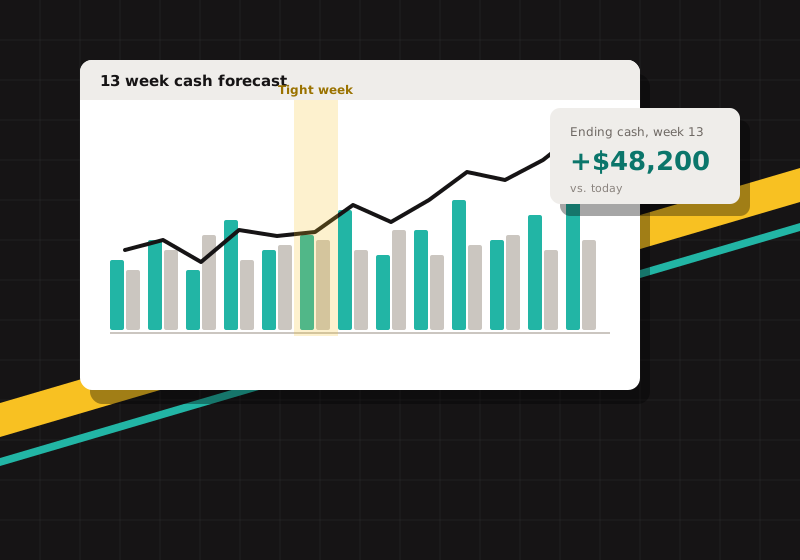
A 13 week cash flow forecast is a week by week projection of the cash your business will collect and spend over the next quarter. You start with today's bank balance, add expected collections, subtract expected payments and see your projected ending cash each week. Update it weekly so actual results replace estimates.
Why 13 weeks?
Thirteen weeks is one quarter. It is long enough to spot a cash crunch while you still have time to act, and short enough that most of the numbers are based on things you already know: invoices outstanding, bills due, payroll dates and loan payments.
Longer forecasts are useful for strategy, but they rely more on assumptions. The 13 week forecast is the practical, operational view. Owners who keep one tend to make calmer decisions because they can see the low points coming.
What do you need before you start?
Gather these before you open a spreadsheet. Most come straight from your accounting software:
- Your current bank balance across all operating accounts
- An accounts receivable aging report (who owes you, and how much)
- An accounts payable aging report (who you owe, and when)
- Your payroll schedule and approximate payroll cost per run
- Loan, lease and credit card payment schedules
- Recurring bills: rent, insurance, software, utilities
- Known one time items: equipment, estimated taxes, owner draws
If your books are not current, fix that first. A forecast built on stale numbers will mislead you. The SBA has a solid primer on managing business finances if you are setting up the basics.
How do you set up the forecast?
Build a simple grid: weeks across the top, categories down the side. Keep it as simple as possible at first. You can add detail later.
| Row | What goes in it |
|---|---|
| Beginning cash | Last week's ending cash (week one uses today's bank balance) |
| Customer collections | Cash you expect to receive from customers that week |
| Other cash in | Loan proceeds, refunds, owner contributions |
| Payroll | Net pay plus payroll taxes on pay weeks |
| Vendors and materials | Payables coming due |
| Operating expenses | Rent, insurance, software, utilities |
| Debt payments | Principal and interest on loans and leases |
| Owner draws and taxes | Distributions and estimated tax payments |
| Ending cash | Beginning cash plus cash in, minus cash out |
Add one more row underneath: your minimum cash cushion. That is the balance you never want to drop below. Any week that dips under it is a week that needs a plan.
How do you estimate customer collections?
Collections are the hardest line to forecast and the most important. Do not assume customers pay on the due date. Use how they actually pay.
- Start with open invoices. Place each one in the week you realistically expect payment, based on that customer's history.
- Add expected new sales. Estimate invoices you will send in coming weeks, then shift them forward by your typical collection time.
- Separate the big ones. If a few customers make up most of your receivables, forecast them individually.
- Be conservative. When in doubt, push a collection a week later rather than earlier.
For businesses paid at the point of sale, like salons and restaurants, collections follow sales closely, but watch processor deposit timing and seasonal swings.
How do you use the forecast to make decisions?
Once the forecast is built, look for the lowest point. That week tells you more than any other number on the sheet. If it dips below your cushion, you have options, and having weeks of notice makes them easier:
- Follow up on older receivables before the tight week
- Ask key vendors for adjusted payment timing
- Delay a discretionary purchase by a few weeks
- Time owner draws around the low point
- Arrange a line of credit before you need it, not during the crunch
The forecast also answers what if questions. Copy the sheet and test a scenario: a new hire starting in week five, a large customer paying 30 days late or a piece of equipment bought outright. You will see the impact on cash instantly.
How do you keep it accurate?
A forecast is a living document. Once a week, replace last week's estimates with actual results, drop the oldest week, add a new week at the end and adjust any assumptions that changed. Fifteen minutes a week is usually enough once the template is set up.
Over time, compare forecast to actual. If collections keep coming in later than you predicted, adjust your assumptions. The forecast gets sharper every month you keep it.
If building and maintaining it yourself is not realistic, this is exactly the kind of work a fractional CFO handles, alongside an annual budget and monthly review.
What does a simple example look like?
Picture a landscaping company with $85,000 in the bank, weekly payroll of about $18,000 and a large commercial client that pays on 45 day terms. The owner builds a 13 week forecast and immediately notices something: in week six, a quarterly insurance payment, an equipment loan payment and two payrolls all land before the commercial client's big invoice is collected.
On paper the business is profitable. In the forecast, week six ending cash drops to about $9,000, well under the owner's $30,000 cushion. With six weeks of notice, the owner calls the commercial client to confirm payment timing, moves a planned mower purchase to week nine and asks the insurer about monthly billing. The low point rises back above the cushion before it ever arrives.
Without the forecast, the owner would have discovered the problem in week six, with far fewer options. That is the entire value of the tool: time to act.
What are the most common forecasting mistakes?
Most forecasts that go wrong share a few habits. Watch for these as you build yours:
- Assuming customers pay on time. Forecast how they actually pay, not what the invoice says.
- Forgetting loan principal. It does not appear on the profit and loss, but it absolutely leaves the bank account.
- Leaving out owner draws and estimated taxes. These are often the largest irregular payments.
- Ignoring three payroll months. With weekly or biweekly pay, some months have an extra payroll. Make sure the forecast catches them.
- Building it once and never updating it. A stale forecast is worse than none, because it creates false confidence.
- Making it too detailed too soon. Start with major categories. Add detail only where it changes decisions.
Common questions
What is the difference between a cash flow forecast and a cash flow statement?
A cash flow statement reports where cash came from and went in a past period. A cash flow forecast projects future cash so you can plan ahead.
Should the forecast be weekly or monthly?
Weekly for the 13 week view, because payroll, rent and big payments land on specific dates. Monthly works for longer range planning and budgets.
What software should I use?
A spreadsheet works well to start. As the business grows, dedicated forecasting tools that connect to QuickBooks Online can save time.
Do I include sales tax in the forecast?
Yes, if you collect it. Arizona transaction privilege tax collected from customers is not your money, so forecast the payment when it is due to the state so it does not look like spare cash.
Can my bookkeeper build the forecast?
Often, yes, especially once the template is set up. Many owners have a bookkeeper update actuals weekly and review the results with a CFO each month.
How long does it take to build the first one?
With current books and the reports listed above, a basic 13 week forecast can usually be built in a few hours. Refining the collection assumptions takes a few weeks of comparing forecast to actual.
How much cash cushion should I keep?
Many businesses aim for a few weeks to a few months of operating expenses, depending on how steady revenue is and how quickly customers pay. Your forecast helps you set the right number.
Want help with this? See our cash flow and forecasting service or book a free consultation with Chris.
 CB
Chris Badulescu is a Certified Public Accountant and the founder of AZ Easy CPA and AZ Easy CFO in Chandler, Arizona. He works with growing businesses on cash flow, budgets, reporting and funding preparation.
Related posts
When does a small business need a fractional CFO?
Seven signs it is time to bring in a part time CFO, and how to tell whether you need a CFO or better bookkeeping first.
How much does a fractional CFO cost in Arizona?
The pricing models fractional CFOs use, what drives the cost up or down, and how it compares to hiring a full time CFO.